




An agentic platform that takes the mundane work off researchers and gives them the leverage to increase output and efficiency.
GWI's core product is selling data as insights with clients including Meta, Amazon, Omnicom and Chelsea FC. I owned the end to end product experience for GWI's internal data tools and systems. From research and synthesis to identifying the business risks and inefficiencies to designing the whole new internal product tool and finally managing the development of the tool itself.

The goal: save the business £750,000 per year and open new revenue opportunities through innovation. Make the data process radically more efficient, collect larger quantities of data faster, and give researchers the capacity to do more with less.
£750,000
Saved per year
x6
Fewer clicks to insights
3
New revenue opportunities
The problem
Current tool has become a Frankenstein
No communication between tools
- “There's so many platforms and so many steps and so many different things to remember… the fact that everything lives in a different place is really frustrating. ”Research operator, GWI
- “Everything lives in a different place”Seams: context lives between tools, not in them
- “Everything is manual right now… there is no automation at all”Labour: humans doing what systems should
- “Tonnage can be finicky… an extra space and it fails… error messages aren't very helpful ”Brittleness: high-cost failures from low-stakes inputs
- “Quotas are not connected to each other… one could block the whole fieldwork without noticing ”Silent failure: no shared state, no shared awareness
- “No clean way to have a contract addendum… it's a hacky system… makes the audit significantly harder ”Business risk: workarounds compound into audit liability
System principles
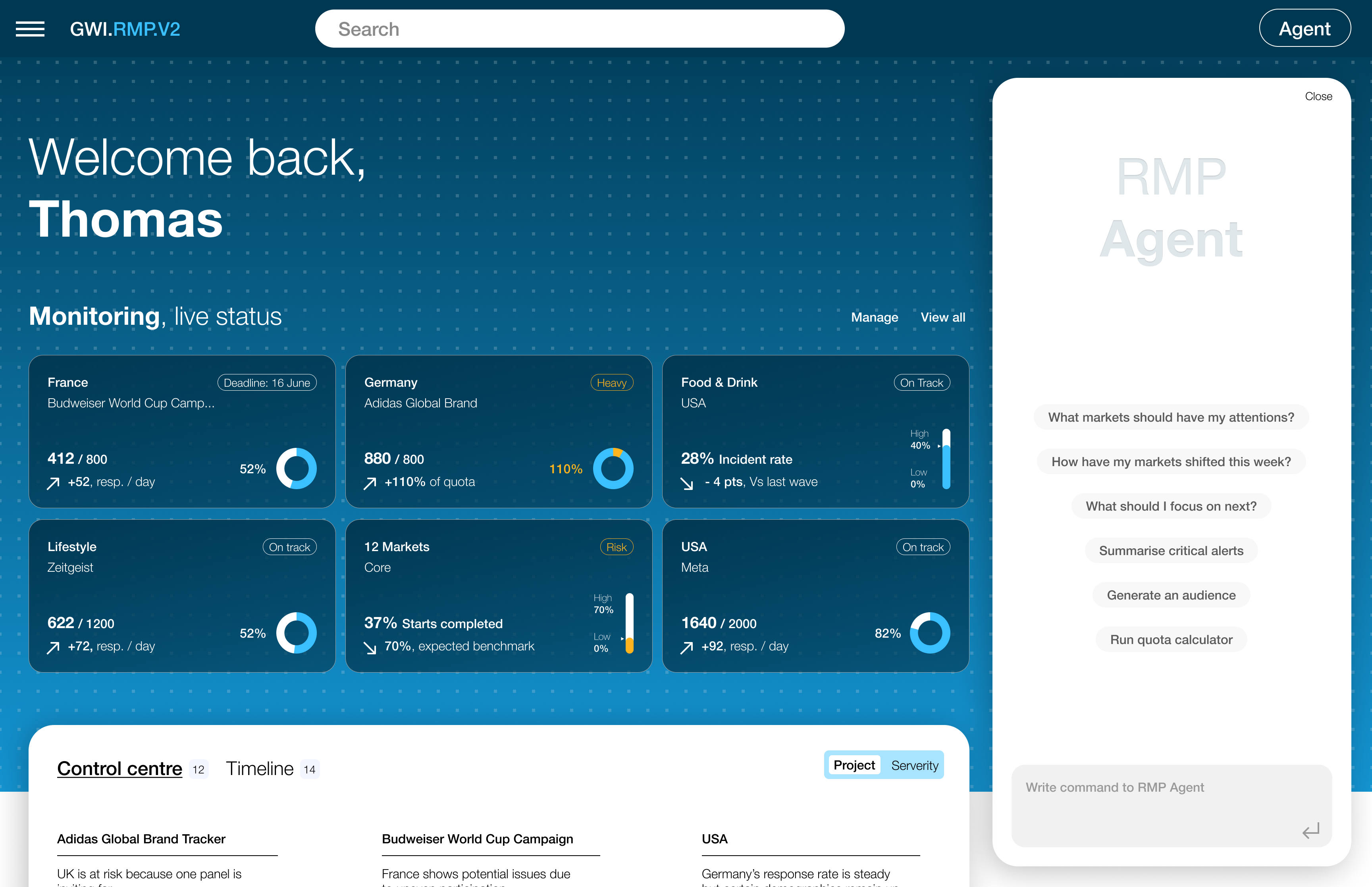
Three layers sit within the ecosystem: a Project Hub that holds the world, a Drafting workflow that changes it, and Fieldwork that runs it. An agent layer sits across all three, not a fourth layer, but the membrane that gives the platform continuous context from project creation to data delivery.
The experience I built
Independent design work, research, design decisions, and UI are all my own contribution.
Five questions shaped where the researcher's attention should go inside the platform.
How do researchers want to identify issues and act on them?
The landing page immediately orientates the user and sizes the priority of developing issues, so the user can make confident, informed decisions with little to no support or wasted time.
What is an agentic architecture that fits user needs?
The agent handles the mundane: chasing approvals, formatting exports, surfacing alerts. The researcher holds the judgement calls, the decisions that shape the data and the recommendation. In order to design this experience, one must understand the flow of information through the data workflow. Understanding what data is available and when, to then serve the correct output at conveniently the right time.
How data flows through the system
Designing agentic data flow
How do operators move from alert to action?
Fieldwork is built for navigation, not monitoring. Search-first IA, with visualisations that act as wayfinding rather than reporting. The agent does the watching; the operator does the moving.
How do researchers want to handle surveys?
With every draft grounded in GWI's own question library (RAG) so consistency is enforced across questions and languages, and stress-tested against simulated respondents (synthetic data) to catch coverage gaps before fieldwork.
How can we save the business money?
By bringing the work GWI currently pays third parties for back in-house. Translation is the clearest example: an automated first pass handles the bulk, with human review focused only on the questions that need judgement. Every surface in the platform is sequenced to replace another piece of outside spend.
What I'd do differently
I'd have challenged the existing ways of working earlier. Some operators are so embedded in the current process they can't see a simpler one exists until you show them, and the longer the legacy ways are the baseline, the harder it is to argue for new foundations. The sandbox prototype eventually moved leadership; I should have built it sooner and shown it wider.