



Nexis+AI is a conversational research tool that identifies the nuanced signals from the noise. Through specialised intent detection, contextually aware responses leveraged on user attributes and innovative navigation techniques, users gain an elevated experience that EY, KPMG and more use.

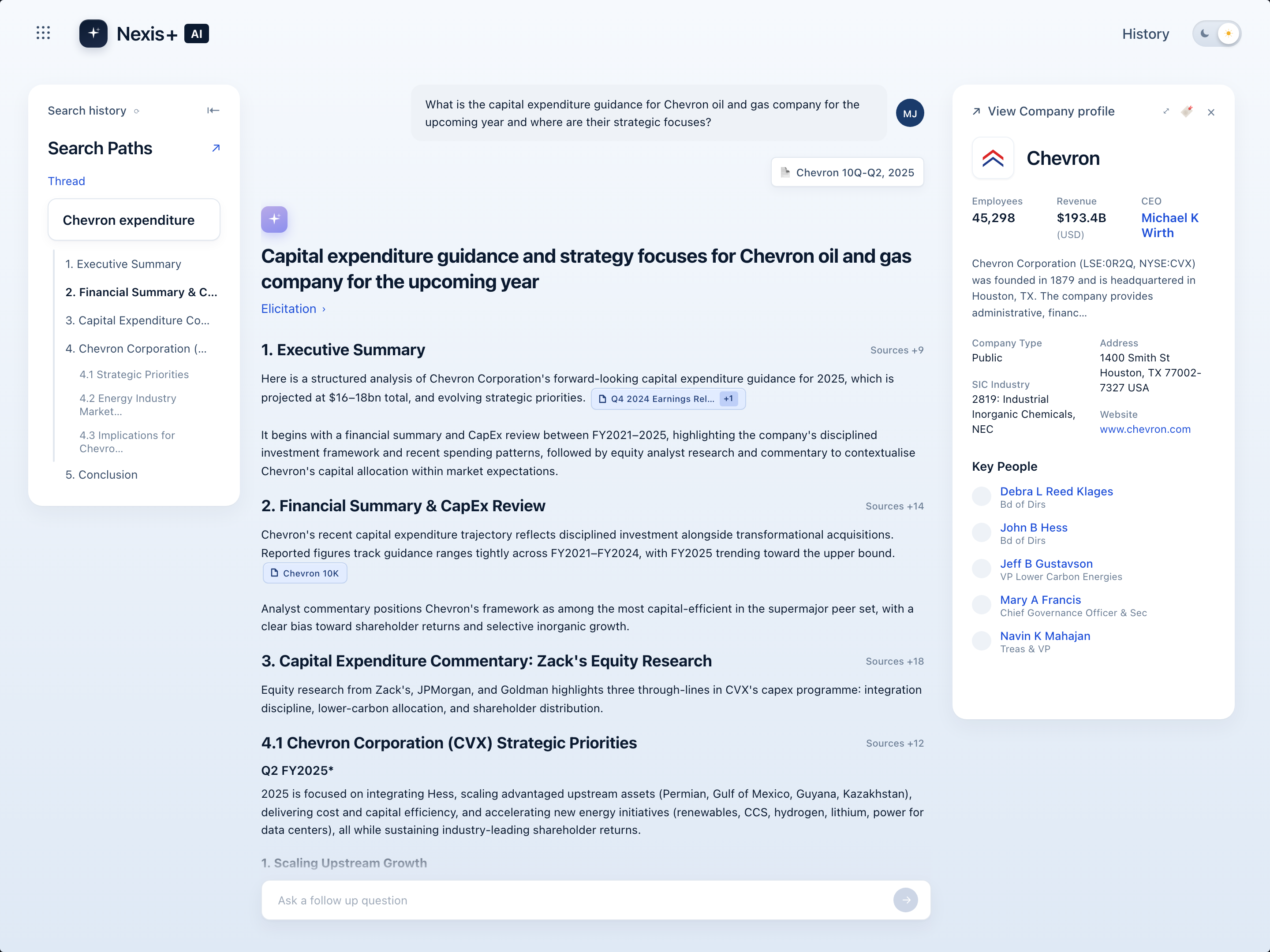
I led product design for Nexis+AI, an AI research platform built for consultants at firms like KPMG and EY. The work covered product strategy, interaction design, design systems, research, and art direction. My task was to surface the signals that matter from inside an overwhelming amount of news, filings, and reports, so consultants can move faster and decide better.
12,000
Global publishers
80%
Preferred over ChatGPT
+100%
Search effectiveness
The problem
Consultants are paid to identify root causes to business problems and make big calls. Whether the task is competitive intelligence, M&A, market analysis, or strategy and advisory, the work turns on the same thing: pulling the few signals that matter out of a vast and growing wall of news, filings, and reports, then shaping them into a recommendation that holds up in a partner review.
The generic AI chat interfaces consultants were already leaning on limit that work in two specific ways.
One answer, no depth
The sources stay hidden
Mental models
Before I start designing any visuals or user flows, it is important to me to get into the users boots and understand their problems deeply. I try to figure out and log the friction points, the behaviours and I then build out different mental model approaches that I believe articulate the ideal solution for the user. These are typically metaphors or abstract principles but they are key to my meticulous workflow with understanding the problem and what the solution should be.
Constellation of Data
The same field of data points, read differently. How those points get connected is what tells the story, competitive intelligence draws one constellation, M&A draws another, market sizing draws a third. The interface makes those connections legible instead of collapsing them into a single confident answer.
Branching
Research isn't a straight line. From a single question, the consultant branches into sub-threads, follows the rabbit holes that look promising, prunes the ones that don't. Every search is a tree the user can fork, return to, and shape, the investigative work stays legible rather than flattening into a chat log.
Progressive Disclosure
Answer first. Evidence second. Source on demand. Each turn of the helix earns the next, the consultant sees the recommendation, then the supporting points, then the citation, only when they ask for it. The interface stays calm at the top and still rewards the consultant who wants to go all the way down.
The experience I built
Independent product design, research, interaction, art direction, and design system are all my own contribution.
Four features did the heavy lifting. Each one answers a question consultants have about doing depth-of-research work inside an AI tool, and each one elevates their search ability past what a generic chat interface can offer.
How can consultants tailor a search to their specific tasks?
With explicit context dials. A competitor analysis needs different sources, structure, and weighting from a market analysis. Contextual search lets users set those conditions explicitly, so the same question returns a meaningfully different answer depending on the lens.
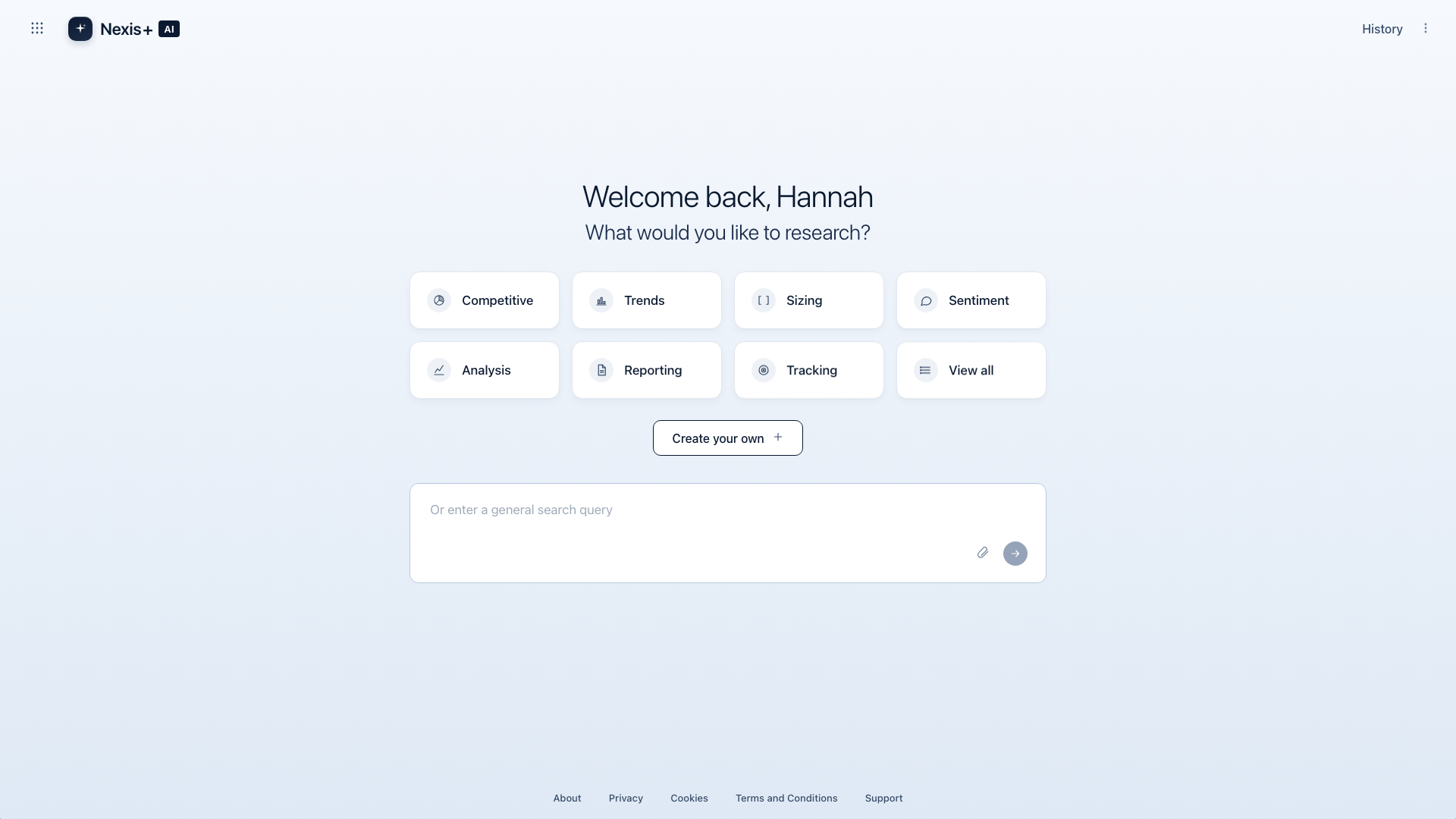
The demo below is a simplified look at how picking a skill completely changes the scope and results of a search, the same question, routed through a different lens, reshapes which topics, sources, timeframes, and geographies the engine reaches for. Getting this right took a huge amount of collaboration with the ML team, alongside my own research and design.
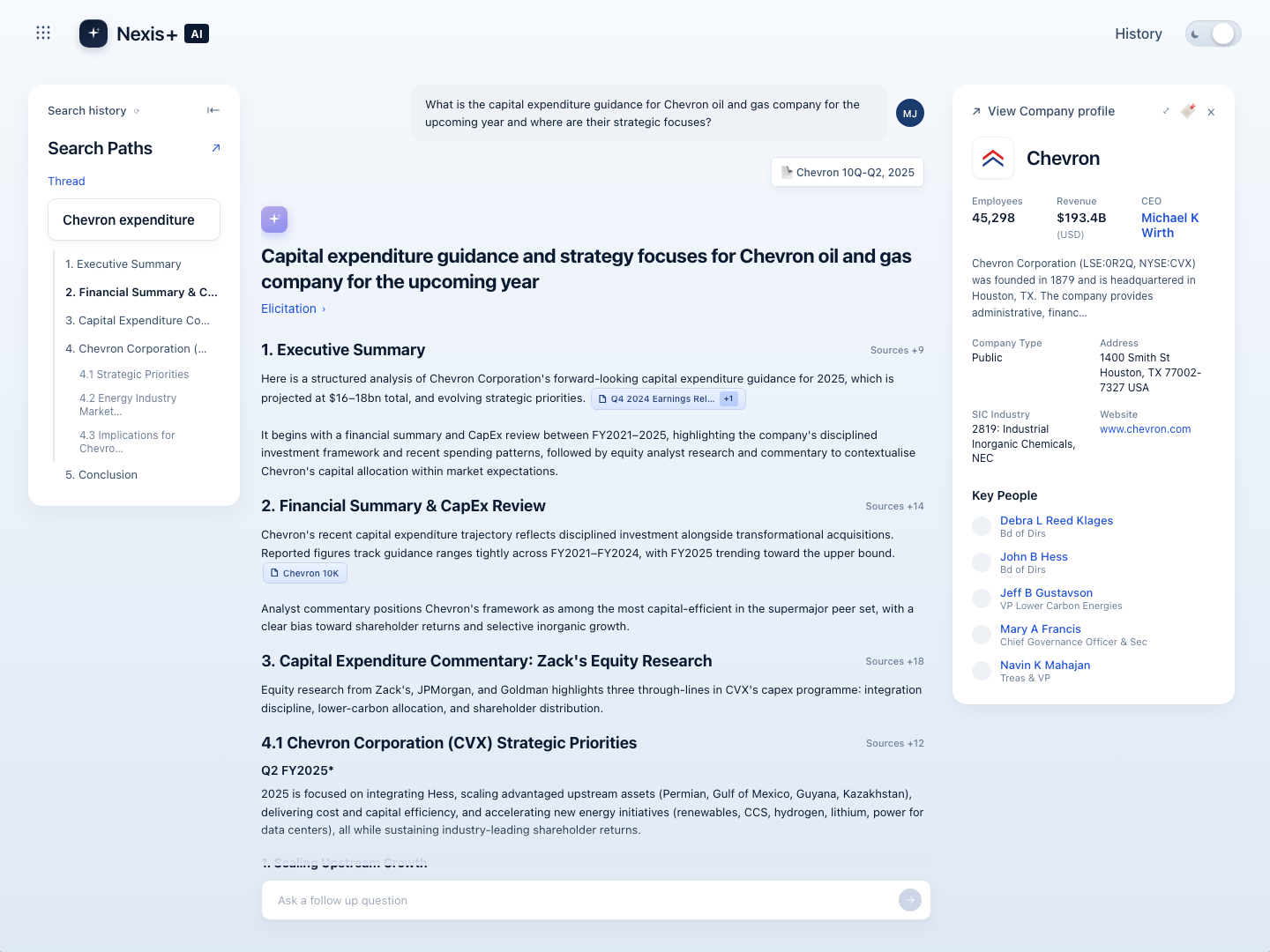
How can consultants elaborate on a response without typing?
By selecting any part of a response and clicking elaborate. The platform widens the net on the existing search rather than starting a new one, no need to re-prompt, no need to pick the right words.
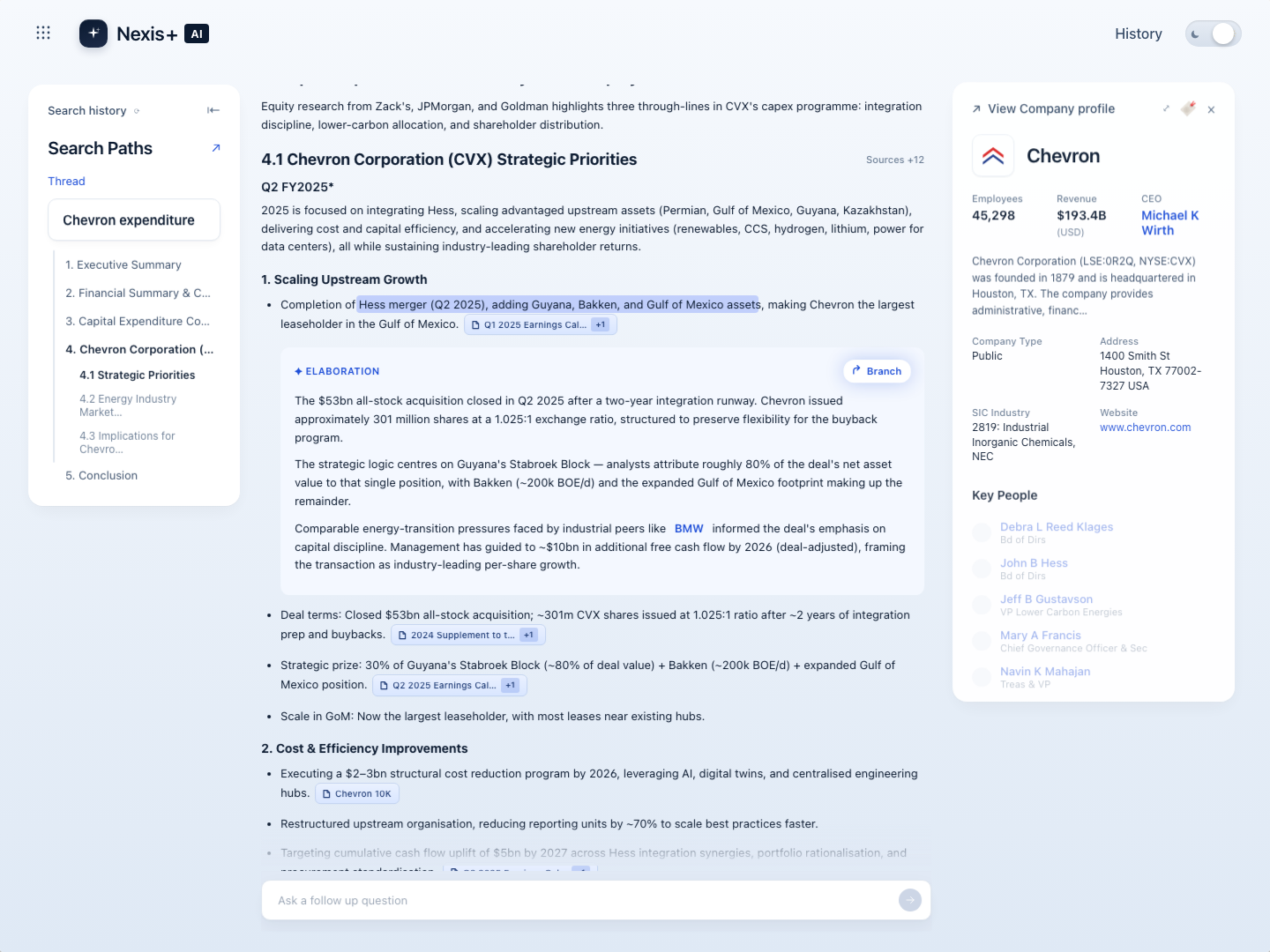
How can consultants explore rabbit holes with confidence?
By branching. From any point in the main search, the consultant spins off a sub-search into its own page, follows the rabbit hole as deep as they want, and returns to the parent thread untouched. The branch structure doubles as a record of how the consultant thinks.
How can consultants verify an answer before they use it?
By anchoring every signal to a source the consultant can drill into. I introduced Time to Validation, the seconds between reading an answer and trusting it enough to use, as a design metric, and tuned inline citations, hover drill-downs, and visible source weighting around it.
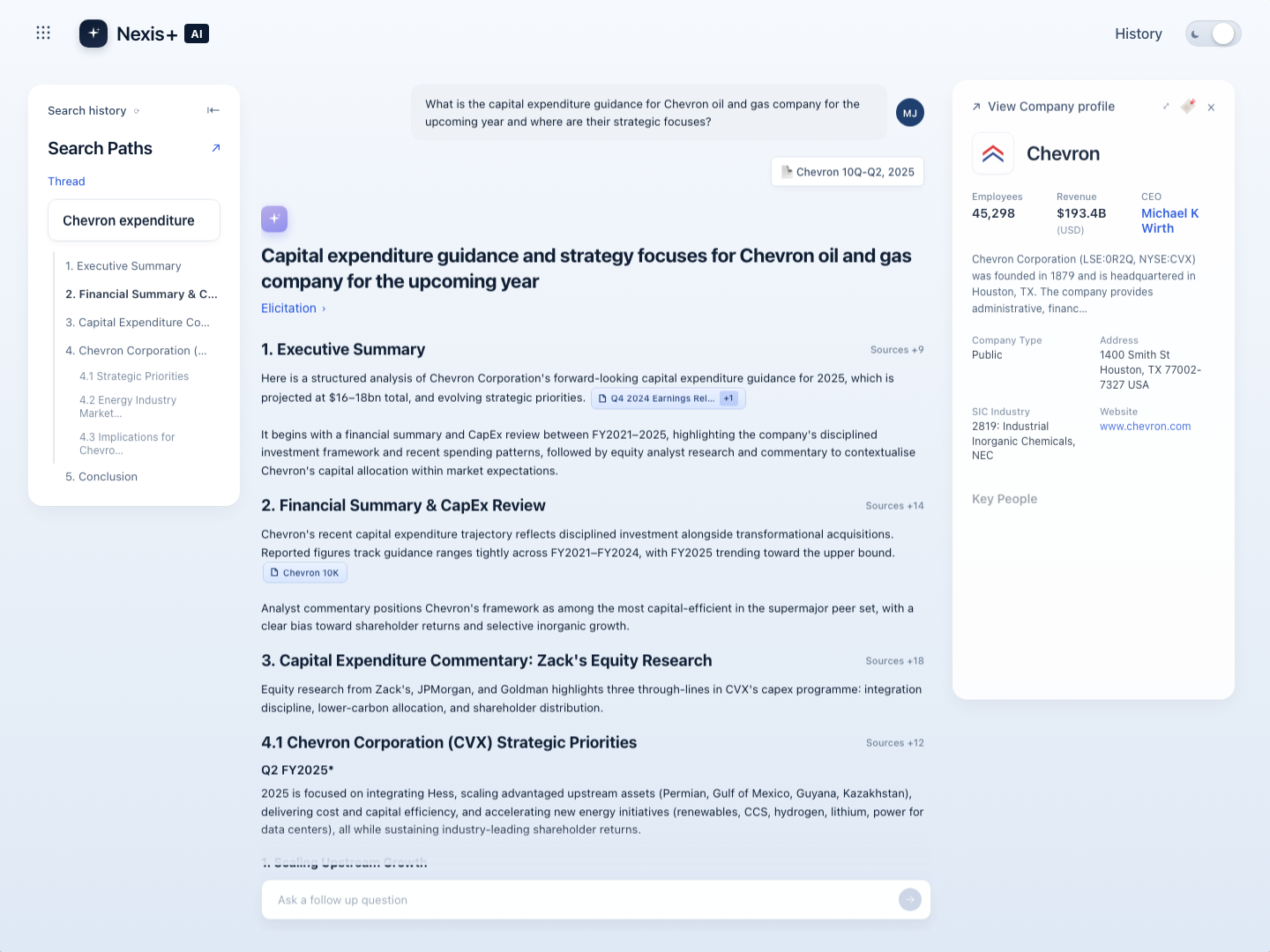
Success benchmarks
Answer Quality Testing
I introduced AQT as a framework to measure response quality systematically. After I identified the prompt-engineering and source-weighting issues and the design fixes landed, AQT showed an 89% lift in response quality. The numbers anchored the case that design had moved the model, not just the screen.
Ideal Response (Co-Designed North Star)
To set the north star, I co-designed the ideal AI response with consultants in the room. Interviews, role mapping, then designing target answers alongside the participants. The artefact gave the team a sharable definition of "good" and became the language leadership used to align around the product's future.
What I'd do differently
A lot of my collaboration with data science involved running experiments and assumptions in parallel, sometimes without realising it. Different intuitions, same questions. Data scientists work from technical intuition; I work from behaviour and systems. We communicate through diagrams, observations, flow charts, and outcomes.
For every collaborator there is a shared language. Find it, and you've found the key. I'd invest in that language earlier and more explicitly on every cross-functional project I lead.